Advocacy
Get Started! (links to sections below)Current Advocacy PrioritiesPresident's 2027 Proposed budget zeroes out funding for the Institute for Museum and Library Services, National Endowment for the Humanities, and makes huge cuts to NEA and National Parks Service. MAM is routinely in contact with staffers in the offices of Maine's congressional delegation, and we continue to advocate for robust funding to these vital federal agencies. Health Insurance Crisis in Maine's Museums |
Save Section 106 of the National Preservation Act On July 24, the Advisory Council on Historic Preservation voted to gut protections and eliminate public engagement on sites eligible for or listed in the National Register of Historic Places. Maine is home to more than 1600 such sites, and if these changes are enacted, federally funded projects such as the construction of highways and transmission lines could be built without public notice or review. The changes would also eliminate the opportunity to identify new sites for the National Register in the same process, and ignore cultural landscapes that are central to the identity, history, and religion of Tribal Nations (as is the case with Katahdin). Section 106 of the National Historic Preservation Act of 1966 encourages preservation. It recognizes that in the real world, not every historic property can be saved, but it ensures that preservation values are key to federal agencies’ planning and decision making. As a result of Section 106, federal agencies are required to engage with the public, and be held publicly accountable for their decisions. The proposed changes would remove both engagement and accountability. We urge you to take a few minutes to call your elected officials, and advocate for protecting Section 106 of the National Historic Preservation Act. You can find excellent resources about Section 106 here (under Additional Resources), as well as scripts and talking points, thanks to Cultural Heritage Partners. Maine's Congressional delegation can be reached at the following numbers: Senator Susan Collins: 202-224-2523 Need a script to help get you started? Here's one from Cultural Heritage Partners: For nearly sixty years, the protections provided by Section 106 of the National Historic Preservation Act have ensured that communities, Tribal Nations, and local governments have that opportunity. I'm asking Senator/Representative ________ to oppose efforts to weaken those protections through either the Administration's proposed regulations or future permitting reform legislation. Weakening these protections will reduce public participation, weaken Tribal consultation, threaten America's historic places, and create more conflict—not less. Please protect the public's voice and oppose efforts to weaken the protections provided by Section 106. Thank you." Upcoming MAM advocacy events
|
.jpg)
Advocacy is information
You have the right, and the duty, to talk to your elected officials and the public about issues affecting your museum. They need to know the good work you do, and what you need to continue your good work. It is as straightforward as a conversation.
Advocacy is not lobbying
Educating public officials and the public about issues affecting your museum is not prohibited by law and will not endanger your nonprofit status. You have a right to advocate on behalf of a cause you believe in. Our legislators and elected officials need the information we provide to help them make informed decisions. Find out more about advocacy vs. lobbying (and so much more!) in this toolkit from the Maine Public Health Association and learn about the rules for nonprofits from the IRS.
Advocacy is Important
Advocacy is active support for a cause – your museum, archive, library, historical society, or historic property. Without advocacy, collecting institutions are not at the table when decisions are made about funding, regulations, public policy, taxes, etc. Cultural organizations are affected in many ways by all levels of government: federal, state, and local.
(adapted from the Virginia Association of Museums)
The American Alliance of Museums offers recorded webinars, toolkits, FAQs, and more. Paper: The American Library Association offers this printable training outline. In-person: MAM offers a free in-person advocacy training at and in advance of Cultural Advocacy Day each year. In addition, these organizations host workshops and conferences that often include training in advocacy:
| It is important for folks in Maine's community of collecting institutions to understand how they can best advocate for their organization and others in the field. Staff and volunteers of nonprofits may worry about how speaking to elected officials and the public about important issues may jeopardize their nonprofit status, but these concerns are largely unfounded. Advocacy 101 from the Cultural Alliance of MaineBrief overview of how you can engage in advocacy efforts for your nonprofit organization. Session was hosted by the Cultural Alliance of Maine and led by Jennifer Wilson, Director of Programming and Advocacy for the New England Museum Association. |
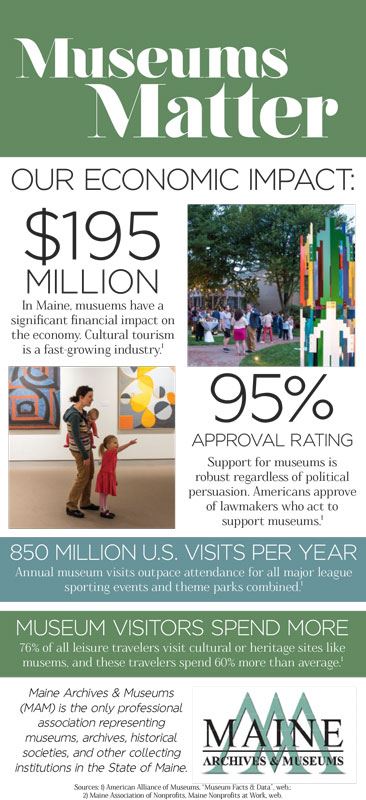
An economic impact statement is a tool that utilizes statistics and compelling narrative to demonstrate the impact that an organization or group has on the economy. Download MAM's economic impact statement of Maine's museums Make your own using this guide from the American Alliance of Museums Feel free to borrow statistics from these reports:
|
|

Developing a Plan for Advocacy: Check out this guide from Community Toolbox or the MAM Advocacy Policy
Advocacy All Year: Check out this sample annual plan for MAM members of small advocacy efforts throughout the year
Read these rules for nonprofits from the IRS. There is very little risk of jeopardizing your nonprofit status.
Getting your news to the media is a great way to advocate for your institution on the local level.
Find your local TV and radio stations using these lists from the Maine Association of Broadcasters
Find your local newspapers using this list from the Maine Press Association
Thanks to Nick Gray and his new Patron View donor database project for partial website sponsorship in 2025.
Never miss an event or important update - Sign up to receive news from MAM!
Join now! Start receiving benefits of membership.
Donate! Support Maine's collecting institutions with a tax-deductible gift.
Use the MAM member app by Wild Apricot to register for events, manage your member profile, and access the member directory.
|
|